Adventure
How to Visit the
The Algerian Sahara is not just a desert. It is the largest hot desert on Earth, and Algeria holds the biggest share of it. Here, silence has a texture, the sky at night looks like a different planet, and the dunes — some standing over 300 metres — shift slowly like sleeping giants. If you're planning to go, this guide covers everything you need to know.
Most travellers who visit desert regions go to Morocco's Erg Chebbi, which is stunning — but tiny. It covers about 50 square kilometres. The Algerian Sahara stretches across nearly 2 million square kilometres. That's bigger than all of Western Europe. The scale changes everything: the silence is deeper, the landscapes more varied, the feeling of solitude more absolute.
What makes Algeria's desert particularly remarkable is its geological diversity. You have the classic golden erg (seas of sand dunes) in the north and south, but also the hammada — flat, wind-blasted rocky plateaus — and the extraordinary tassili formations: canyons and mesas sculpted by millions of years of erosion. The Hoggar mountain range rises dramatically from the desert floor, its volcanic peaks dark against the amber landscape. No other Saharan country packs this variety into one accessible region.
And then there's the cultural dimension. The Tuareg people — the indigenous nomadic Berbers of the Sahara — have lived here for thousands of years. In Tamanrasset and Djanet, you'll encounter their traditions, music, crafts, and philosophy of desert life. Many of the best guides are Tuareg men whose families have navigated these landscapes for generations.
Local insight: Most visitors only see the dunes near Tamanrasset or do a single overnight. If you can spare 5–7 days and reach Djanet, you'll see an Algeria that barely 10,000 foreign visitors experience each year.
Tamanrasset ("Tam" to everyone who lives there) is the gateway city of the Algerian Sahara, sitting at an altitude of 1,400 metres on the edge of the Hoggar mountain range. The Hoggar is not what most people picture when they think "Sahara." It's volcanic and rugged, with jagged peaks of dark basalt and rhyolite rising from flat plains. The most iconic sight is the Assekrem plateau, where the French hermit Charles de Foucauld built a hermitage in 1911. The sunrise from Assekrem — with the volcanic towers turning gold and purple — is one of those views that resets your understanding of beauty. Getting there requires a 4x4 and several hours of driving on rough tracks.
Around Tam you'll also find the In-Amguel dunes, accessible on day trips, and the remarkable rock carvings of the Saharan Neolithic period scattered across the surrounding hamadas. Local guides know exactly where to find them.
Djanet is arguably the most spectacular destination in the entire Algerian Sahara — and one of the most undervisited extraordinary places on Earth. The town sits in a lush palm oasis at the edge of the Tassili n'Ajjer plateau, a UNESCO World Heritage Site and one of the most significant archaeological zones in Africa. The Tassili's sandstone formations are extraordinary: labyrinthine canyons, wind-carved arches, and pillars called "Algerian forests of stone." Hidden within these formations are thousands of rock paintings and engravings, some dating back 10,000 to 12,000 years, depicting animals, people, and scenes of daily life from when the Sahara was green.
Access to the Tassili proper requires a multi-day trekking permit and a certified guide. Most visitors do 3–5 day circuits, sleeping under the stars among the formations. It is physically demanding but among the most profoundly moving travel experiences available anywhere.
If you want the classic dune experience — the enormous golden sea of sand — the Grand Erg Oriental, accessible from Biskra or Touggourt in the north, is where to go. These are the largest continuous dune fields in Algeria. The ergs near El Oued are particularly accessible by road from Algiers or Constantine (roughly 600–700 km), making them suitable for shorter trips. The towns of El Oued and Touggourt are themselves interesting: El Oued is called "the city of a thousand domes" for its distinctive Mozabite-influenced domed architecture.
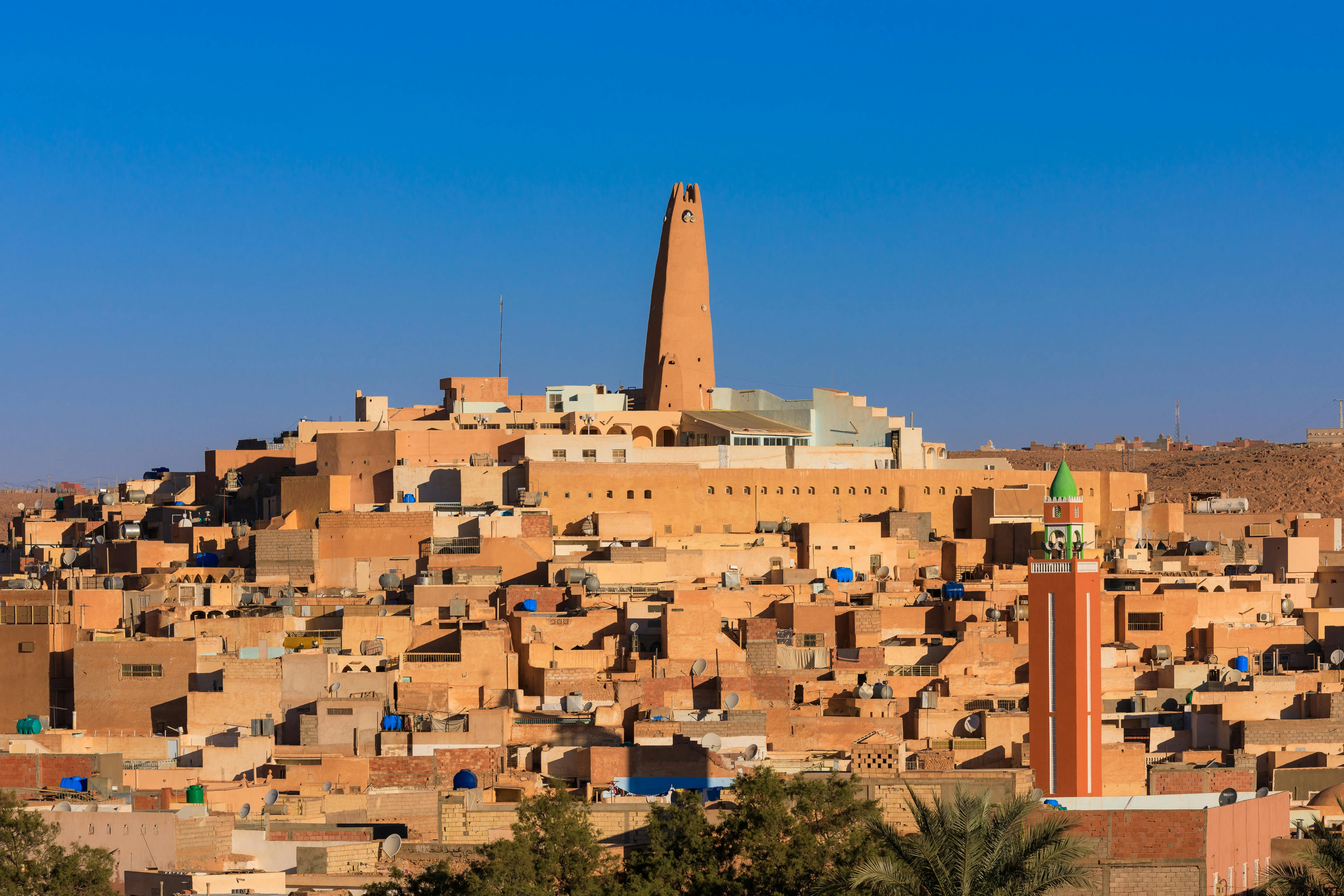
Technically on the northern edge of the Sahara, Ghardaïa and the M'Zab Valley are often included in Sahara itineraries and deserve their own visit. The valley contains five medieval fortified cities built by the Ibadi Mozabite community in the 10th and 11th centuries, all UNESCO-listed. The architecture is extraordinary — organic, whitewashed, perfectly adapted to the desert heat — and it directly inspired Le Corbusier's theories of modernist urban planning. The local community is welcoming but traditional; dress modestly and ask before photographing people.
The Hoggar Mountains near Tamanrasset — volcanic peaks that rise unexpectedly from the desert floor.
The Saharan climate is extreme, and timing matters enormously. Here's the honest picture:
| Season | Temperatures | Verdict |
|---|---|---|
| October – February | Days 18–25°C, nights can drop to 0°C | ✅ Best time — cool days, cold nights |
| March – April | Days 25–35°C, nights mild | ✅ Good — shoulder season, fewer crowds |
| May – June | Days 35–45°C, nights 20–25°C | ⚠️ Hot but manageable with preparation |
| July – September | Days 45–50°C+ | ❌ Not recommended for most visitors |
December and January are the absolute peak months for Tamanrasset and Djanet, coinciding with local festivals and the highest number of organised tours. Book guides and accommodation well in advance if travelling then. November and February are excellent alternatives with fewer tourists.
Many first-time Sahara visitors don't expect cold nights. In December and January near Tamanrasset, temperatures regularly drop to 2–5°C after dark, and can hit freezing at altitude (Assekrem sits at 2,728m). A quality sleeping bag and warm layers are non-negotiable, not optional extras.
The easiest way to reach the deep Sahara is to fly. Air Algérie operates regular domestic flights from Algiers (Houari Boumediene Airport) to Tamanrasset (TGR) and Djanet (DJG). Flight times are approximately 2 hours. Fares vary considerably — booking 3–4 weeks in advance gives the best prices. Flights to Djanet can be infrequent; double-check the current schedule as it changes seasonally.
El Oued (EBH) and Biskra (BSK) are also served from Algiers and are good entry points for the Grand Erg Oriental.
The Trans-Saharan Highway (RN1) runs the full length of Algeria from Algiers to the Mali border, passing through Ghardaïa, In Salah, and Tamanrasset. The total distance from Algiers to Tamanrasset is approximately 1,900 km. Some travellers drive this route in private vehicles or rent 4x4s; the road is paved but remote, and fuel stops require planning. Never attempt the Saharan road sections without a full spare tyre, extra water (minimum 10 litres per person), and a downloaded offline map.
For most international visitors, booking a guided Saharan tour is the most practical option. Reputable agencies based in Tamanrasset and Djanet offer packages ranging from 3-day dune excursions to 10-day Tassili treks. Prices vary widely; see the budget section below. We strongly recommend using a licensed Algerian guide — not only is it legally required in certain protected zones, it also transforms the experience. Tuareg guides bring knowledge of the land, its history, and its stories that no guidebook can replicate.
There is something genuinely irreplaceable about crossing dunes on camelback at dawn, when the sand is cold and the light is rose-gold and the animal beneath you moves with ancient rhythm. Single-day camel excursions are available near Tamanrasset and around El Oued. For serious trekkers, multi-day camel caravans into the Erg Admer or the Tassili foothills are a different experience altogether — slower, harder, and far more rewarding.
The Algerian Sahara has virtually zero light pollution across vast areas. On clear nights, the Milky Way is so bright it casts a faint shadow. The Hoggar region in particular is recognised as one of the finest stargazing locations on Earth. Bring a red-light headtorch (to preserve night vision), download a star map app offline, and ask your guide about the Tuareg names for the constellations — they have their own astronomical tradition, rich with poetry.
If you have experience with off-road driving, renting a 4x4 and exploring the tracks around Tamanrasset with a local guide is exhilarating. The tracks to Assekrem, the Atakor plateau, and the In-Amguel valley require genuine off-road driving skill and a mechanically sound vehicle. Never go alone; always travel in convoy with at least two vehicles on serious tracks.
The Tassili n'Ajjer contains the world's largest concentration of prehistoric rock art. The most accessible major site is the plateau around Djanet, where licensed guides lead 3–5 day circuits to sites including the famous "Round Head" paintings — stylised human figures of unusual sophistication — and engravings of elephants, giraffes, and cattle from when the Sahara was verdant savanna. Photography is permitted but flash is forbidden.
With the right guide, it's possible to visit semi-permanent Tuareg encampments and experience the famous Tuareg tea ceremony — three tiny glasses of progressively sweetened mint tea, served slowly, with conversation. This is not a tourist performance; it is a genuine expression of Tuareg hospitality, and it comes with the expectation of reciprocal respect. Turn off your phone, sit cross-legged, and be present.
Access to the Tassili n'Ajjer National Park requires a park entry permit, which your guide or tour agency will arrange. Foreign visitors are required by Algerian law to be accompanied by a licensed guide in all protected national park zones. Additionally, foreigners travelling outside of major cities must register their presence with local authorities (your guide handles this). None of this is onerous in practice, but do not attempt to visit Tassili independently without a licensed operator — you will be turned back at checkpoints.
| Item | Approx. Cost |
|---|---|
| Return flight Algiers–Tamanrasset | 6,000–12,000 DZD (~$45–90 USD) |
| Budget guesthouse (Tamanrasset) | 2,000–3,500 DZD/night |
| Licensed guide per day | 4,000–7,000 DZD/day |
| 3-day organised dune/Hoggar tour | 30,000–55,000 DZD/person |
| 5-day Tassili trekking tour | 70,000–120,000 DZD/person |
| Camel hire per day | 3,500–5,000 DZD |
| Meal at local restaurant | 400–900 DZD |
Note: These figures are approximate as of early 2025. The official DZD exchange rate is available at Algerian banks; the parallel market rate (which many travellers use) offers substantially better value. Carry cash — there are ATMs in Tamanrasset but they are unreliable for foreign cards.
Money tip: Withdraw cash in Algiers before heading south. Tamanrasset has a few ATMs but availability for foreign cards is inconsistent. Most Saharan guides and services are cash-only.
Packing for the Sahara is a balance between desert heat and surprisingly cold nights. Here is what locals and experienced desert guides consistently recommend:
The Algerian Sahara is not a comfortable destination. Logistics are harder than Morocco or Egypt, infrastructure is thinner, and the distances are staggering. But precisely because of all this, it remains something rare in the modern world: a place of genuine, undiluted wildness. The travellers who come here and go slowly, who listen to their guides, who are willing to sit with discomfort and silence — they leave changed in ways that are difficult to put into words.
If you go, take care of it. This desert belongs to the Tuareg, and to the wind, and to time.