Destination
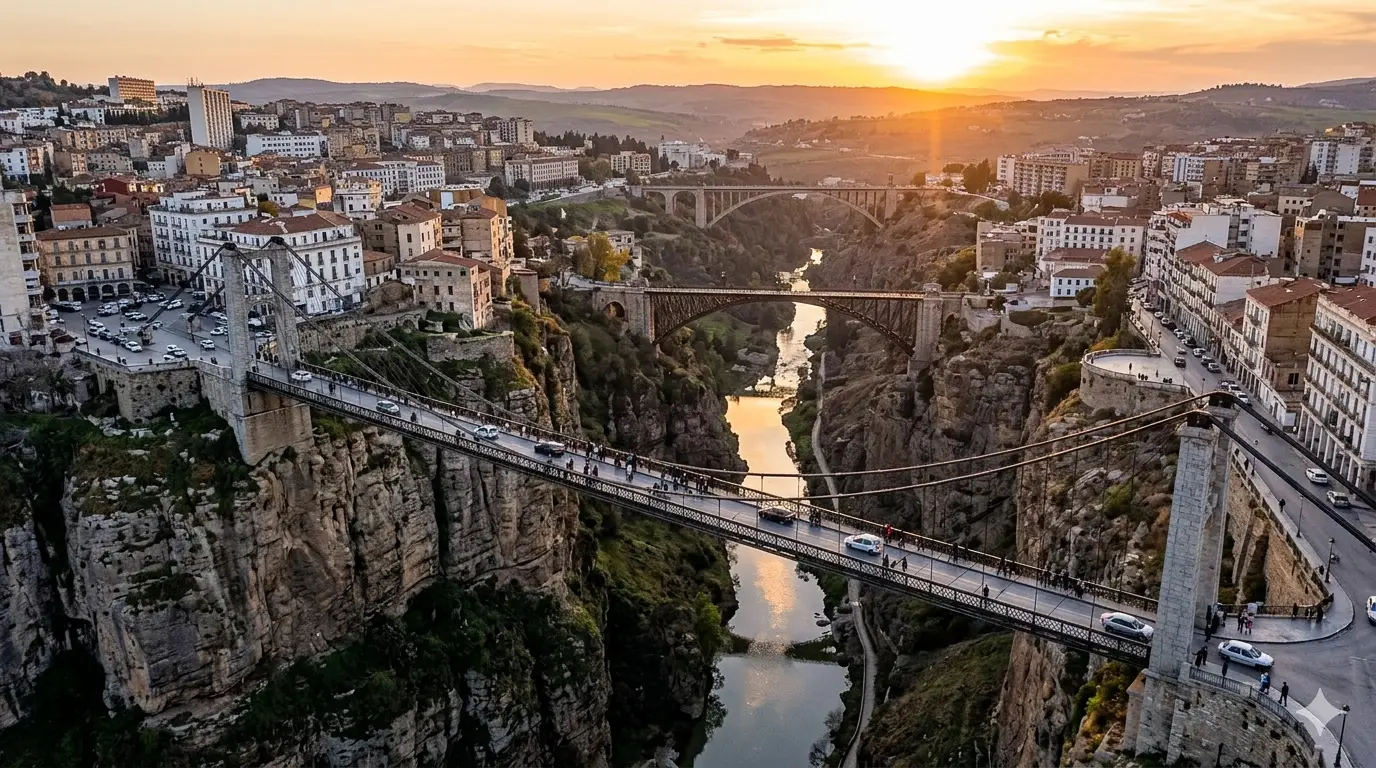
Constantine is a city that defies easy description. It sits on a rocky plateau carved into islands by the dramatic Rhummel gorge — a canyon that plunges 200 metres below the city streets. Seven bridges, some suspended hundreds of metres above the void, connect the city's rocky outcrops. Walking across them at sunset, with the gorge roaring below and the call to prayer echoing off the ancient stones, is one of the most unforgettable experiences in North Africa.
Constantine is one of the oldest continuously inhabited cities in the world. It was founded as Cirta more than 2,500 years ago, serving as the capital of the Numidian kingdom under Massinissa and later Jugurtha. After the Romans defeated Jugurtha, Cirta became an important Roman provincial city, and the ruins of the Roman period still surface throughout the modern city — in the museum, beneath construction sites, in the ancient water cisterns that still underlie parts of the old town.
The city was renamed Constantina in the 4th century AD by the Emperor Constantine the Great, who rebuilt it after it was destroyed in civil war. Constantine is also the name it still bears today — one of the few Roman place names to survive in North Africa almost unchanged across 1,700 years.
The Islamic period brought the great mosques and the medina that still define the city's upper plateau. The Ottomans made it a significant bey-lik (provincial capital), and the Ottoman-era architecture around the old kasbah area is among the best preserved in Algeria. French colonisation from 1837 brought the grand boulevards and colonial buildings that contrast starkly with the old medina — and the technology to build suspension bridges across the gorge that the city's ancient inhabitants could only dream of.
Constantine's bridges are its defining feature — both physically and psychologically. The city's geography forced its inhabitants to become bridge builders of extraordinary ambition.
The most dramatic of all — a suspension bridge 175 metres above the Rhummel gorge. One of the highest bridges in the world when it was built. Walk it at dusk for maximum impact.
A Roman arch bridge rebuilt by the French. The most historic of Constantine's crossings, with Roman foundations still visible. Connects the old city to the newer districts.
The newest of the major bridges, with a striking modern cable-stayed design. Lit dramatically at night. Good viewpoint from the opposite bank of the gorge.
A lower-level crossing that offers views up toward the more dramatic bridges above. Less visited and therefore more peaceful — a good place to photograph the gorge from below.
Photography tip: The best photo of Sidi M'Cid Bridge is taken from the opposite bank of the gorge, looking back toward the city. Ask a local to point you toward the viewpoint — it's a 15-minute walk from the bridge itself. Golden hour is extraordinary.
Constantine's main museum is housed in a handsome colonial building near the central market and is one of the better regional museums in Algeria. The ground floor covers prehistory through the Numidian, Carthaginian, and Roman periods — the mosaics and Roman-era sculptures recovered from Tiddis and nearby sites are particularly fine. Upper floors cover Ottoman and colonial history. Explanatory texts are in French and Arabic; the staff can sometimes provide informal English guidance if asked politely.
Constantine's medina is compact but atmospheric, clustered on the highest point of the rocky plateau. The souk area around Rue Diderot and the central market sells traditional Constantinian jewellery — the city is famous for its distinctive goldwork and silver filigree traditions, particularly the "tabzimt" (women's brooch) that has been made here for centuries. The medina streets narrow and twist in ways that reward wandering; let yourself get slightly lost and you'll find workshops where craftsmen are doing things exactly as they were done 200 years ago.
Built in the early 19th century by the last Ottoman bey (governor) of Constantine, this palace is one of the finest examples of late Ottoman architecture in North Africa. The interior courtyards, with their carved stucco, painted wooden ceilings, and marble fountains, are exquisite. It was Ahmed Bey who led the city's famous resistance against the French siege of 1836 — a story that is told with great pride in Constantine. The palace is open to visitors; check current hours as they change seasonally.
Some 30 km northwest of Constantine, the ruins of the Roman city of Tiddis occupy a dramatic hilltop site. It's less visited than Timgad or Djémila but has its own beauty — a compact, mostly excavated Roman town with temples, cisterns, and a mausoleum, and views across the Tell Atlas mountains that are genuinely spectacular. A half-day excursion by taxi from Constantine is perfectly manageable.
Constantine has a rich food culture that draws on Berber, Arab, Ottoman, and French influences, and the city is particularly known for its sweets and pastries — regarded by many Algerians as the finest in the country.
Constantine's signature dish is trida — thin sheets of home-rolled semolina pasta cooked in a rich broth with vegetables and lamb or chicken, finished with dried fermented milk (smen) and a drizzle of olive oil. It's preparation-intensive and therefore mostly found at home cooking and traditional restaurants; if you see it on a menu, order it. Some families prepare it for special occasions only, so consider yourself lucky if you're invited to eat it at someone's home.
The pastisseries of Constantine have a reputation across Algeria that is well deserved. The local specialties include "zlabia" (spiral honey-dipped fritters, consumed especially during Ramadan), "griwech" (bow-tie shaped fried pastry with honey and sesame), and a range of almond-based confections unique to the city. The pastry shops around the central market area are worth visiting even if you don't have a sweet tooth — the craft on display is remarkable.
| Option | Details |
|---|---|
| By Air | Mohamed Boudiaf International Airport (CZL), 10 km from city centre. Flights from Algiers (1 hr), Paris, Lyon, Marseille. |
| By Train | Trains from Algiers take approximately 5 hours. The station is centrally located. Good option if you want scenic views of the Tell Atlas mountains. |
| By Bus | Regular long-distance buses from Algiers (5–6 hrs), Annaba (2 hrs), Sétif (1.5 hrs). |
| Getting around | Taxis are plentiful and cheap. The city centre is walkable; the bridges and old medina are best explored on foot. Cable car (téléphérique) operates above the gorge — currently intermittently; check locally. |
| Where to stay | Hotels are concentrated in the modern city centre. Book in advance during university exam periods (when all rooms fill) and during the annual cultural festival in April. |
Constantine demands to be taken seriously. It's not a city for a quick Instagram stop at the bridges and a departure — though the bridges alone justify the journey. It's a city whose depth reveals itself slowly: in the layers of history embedded in its stones, in the craftsmanship of its souks, in the particular pride and warmth of its people. Stay at least two nights. You'll need them.